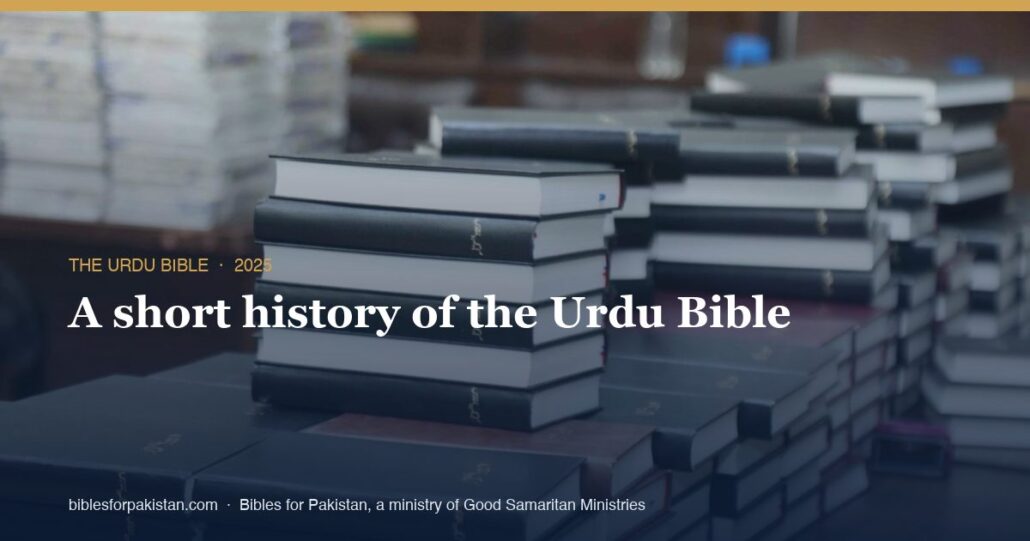
When Bibles for Pakistan hands someone a Bible, the book they receive is the fruit of more than two centuries of translation, revision and printing. Here is the story in brief.
The first New Testament
The first translation of the New Testament into Urdu, then more often called Hindustani, was made in the early nineteenth century by Henry Martyn, a chaplain and scholar, working with Indian colleagues. It was completed around 1810 and printed in 1814 at Serampore, near Calcutta, which was then the great centre of Bible printing in South Asia. Martyn’s translation was remarkable for its time and set the pattern for everything that followed.
The complete Bible
Translating the Old Testament took longer. The complete Urdu Bible, Old and New Testament together, was published in 1843. Over the following decades committees of missionaries and Indian Christian scholars revised the text book by book, producing the Urdu Revised Version towards the end of the nineteenth century. It is this revised text, lightly updated since, that Pakistan’s churches read today, and that Bibles for Pakistan distributes.
Bibles in Lahore
Lahore became a centre of Bible work early. The Punjab Auxiliary of the Bible Society was founded in the city in 1863, and the Pakistan Bible Society, which continues that work, is still based there. Bibles for Pakistan is also based in Lahore, at Good Samaritan Church, and buys its Bibles from Pakistani printers so that the work supports the church at home.
Why the history matters
Every Urdu Bible carries this history. The words a village family reads on a Sunday evening were weighed and reweighed by people who gave their lives to the task, so that the Scriptures could be read by ordinary people in the language they speak at home. Our part is simpler: to make sure the book reaches them.
Do you need a Bible?
Anyone in Pakistan can receive a free Urdu Bible, regular or children’s edition, delivered within {{delivery}}. Request a free Urdu Bible, or pray with us for the next distribution.